"I reject out of hand the notion that poets of my generation are practicing mere experimental aestheticism."
-Some dude on the Flarf page
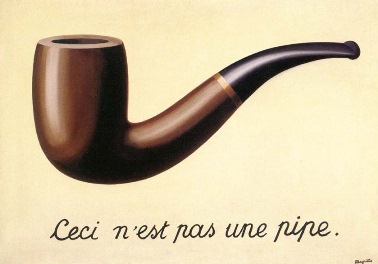
As interesting as I find flarf poetry, I take severe issue with this quote. While the principles of flarf are interesting in the same manner that Dadaism and Situationism and Futurism and other absurd art movements are interesting, I disagree with that statement because Flarf is exactly experimental aestheticism. Perhaps the argument here is against the label "mere", but Flarf isn't poetry in the same way that Charles Bukowski or Rimbaud is poetry; it's an experiment in the same vein as The Treachery of Images is. I look at that painting and it makes me want to think, to turn things over in my head and maybe arrive at the same conclusion that Magritte did, but it doesn't make me feel anything, which is ultimately the point of art. All forms of art and self expression are really just enhanced means of communication: watch a group of musicians improvise together and it's clear they're doing a whole hell of a lot of talking without words. But looking at The Treachery of Images doesn't make me feel anything beyond vague fascination. Compare this with, say Starry Night, which is a painting that makes me want to weep, and it's clear that art can function either intellectually or viscerally, but it's much better when it functions viscerally.
This is an opinion though; i'm sure there are people for whom Flarf causes intense emotional reaction. i don't want to meet these people; their conception of art is so radically different than mine that it has defeated the purpose of art: rather than communicating, it's alienating.
But after hating on it so hard, i have to admit that i do enjoy the fact that Flarf came into being as a protest against the commodification and asinine web exploitation of poetry. reactionary art can sometimes be incredible, but i still maintain that without an actual emotional base, Flarf is exactly what the above, unnamed gentleman is claiming it isn't', experimental aestheticism. Not that this is always bad, experimental aestheticism gave us Impressionism, graffiti, etc. But to try and pass it off as a legitimate form of poetry is deceptive and to me, incredibly irritating. Of course there are considerations of form and rhythm, but, as i'm sure everybody in class is going to prove, all you really have to do is put shit into google and then randomly copy and paste it into a word document. Flarf makes poetry further and more needlessly esoteric, if it's going to survive as an art form, poets should strive for clarity and simple beauty that can be understood by people that don't necessarily understand phrases like "experimental aestheticism".
But maybe that's what they want. Maybe they want a further secret handshake into the art world, to create further exclusivity and continue poetry's already solipsistic tendencies. But my honest response towards this is aversion, because it so radically diverges from what i believe art should do. Then again, maybe that's a good thing.
Monday, March 23, 2009


Monday, March 16, 2009
McCaffery: Prompt 1
The "readerly dilemma" presented by Carnival, the first panel is not a new one. The idea that art is at its most pure when transient or on the brink of destruction has been explored by several artists in the past as well as artists working currently today.
1. French theorist and writer Guy Debord explored this idea with the publication of his first book, Memoires, which was bound in sandpaper so that every time the reader wished to view the book, the mere act of pulling it off the bookshelf would destroy the books that surrounded it. to avoid this act, one had to dedicate separate shelf space to the book. Debord's work often concerned the idea of 'the spectacle' and the resulting social alienation that derived from a media-controlled and saturated way of modern life.
2. British band the The Durutti Column released an LP that was bound in sandpaper, which was an obvious homage to Debord, but the execution of which involved a neat twist: rather than use sandpaper for the outside of the album cover, as Debord had with his book, The Durutti Column used sandpaper for the inside of the LP case, which meant that every time a fan would go to listen to the album, the very act of removing it from its sleeve would cause damage to the vinyl, gradually reducing the sound of the music to a series of pops and fuzz. This begs the interesting question as to whether the band did this to force an alteration to the sound of the record with each listen or to simply destroy the music so that each listening session would gain meaning.
3. Currently operating punk/cabaret sideshow band The World/Inferno Friendship Society bases much of their lyrical content on the idea that the best music is live, that recorded music reduces spontaneity and that "nothing bought or sold is good for posterity". A song on their most recent album, Addicted to Bad Ideas, contains the following lyrics
"Every commercial makes us die, a little bit
Every pop star makes us doubt, a little bit
Every new car makes us choke
On how little air we get and how we get it
The celebrity makes us filthy, a little bit
Every single ad makes us gag, a little bit
Every photograph makes us age
Each sound bite deafens, each sales event condemns
Because every new car you buy
It makes the poor baby Jesus cry
Nothing bought or sold is good for him
For you, for me, not good for anybody"
Sunday, March 1, 2009
Reading Response: Graffiti Lives
“Since active writers are extremely secretive about their identites, the Vandal Squad has often made very public arrests of older writers who are transitioning out of crime and have begun to focus more on art.”
Reading Graffiti Lives made me how bizarre the dichotomy between graffiti as vandalism and graffiti as art is. Synder discusses the concept of graffiti as a crime came from the so-called 'broken windows' theory addressed in my last post, as well as the purported link between graffiti and gang violence. Much is also made of the transition of young artists into adulthood and their subsequent sacrifice of the graffiti lifestyle. These thoughts led me to do research on the lives of two popular modern graffiti artists, Banksy and Shepard Fairey, both of whom I discussed in previous posts.
Much of Banksy's life in public is conducted through interviews that find him wearing a mask or altering his voice in some way. Footage of him captured on Closed Circuit Television in the Louvre and other museums he has hung his own art up in usually has him wearing a mask or some other outrageous disguise, and several warrants are currently out for his arrest. Although this habit presumably allows him to operate in normal life with some degree of freedom, the idea that Banksy's identity as an artist will be forever disguised because of the nature of his art is an interesting one.
Shepard Fairey provides us with a much more timely example, and one extremely illustrative of the opening quote of this post.
As the artist responsible for the iconic "OBEY" stickers and the original "Andre the Giant Has a Posse", Fairey rose to prominence in conjunction with the skateboarding scene in and around Boston, and used the notoriety gained by the spread of the "OBEY" campaign to create a career for himself as a respected and legitimate artist, doing work for numerous bands and movie studios. Fairey is now most famous for his iconic "HOPE" poster, created from an AP image of President Obama. Unfortunately, Fairey's high profile now means that he getting arrested on decades-old vandalism charges resulting from some of his first postings of the "OBEY" art in and around Boston.
Whether this is a concerted act of intimidation and a warning to all graffiti artists that it is impossible to escape their pasts or some kind of novice hatchet job, attempting some kind of half-assed character assassination so that Fairey will always been seen as a vandalizing criminal and not a respected contemporary artist remains to be seen. But clearly the prejudice against graffiti still exists, and along with it a childish tendency to hold grudges and punish people with a bulldog like tenacity for crimes long forgotten.
Graffiti Assignment 2
Despite professing hatred for the internet, I have to confess that I spend a large amount of time browsing various image searches on a semi-daily basis, and ever since acquiring my laptop, these searches have been categorized and chronicled by subject, so when I found it was time to examine graffiti in a certain 'area', I took that area to be the saved pictures folder on my hard drive that features about 2 years of various graffiti pictures I've pulled off the internet for various reasons.
So it was this quote in Graffiti Lives that interested me most because I recognized in it my own interest in graffiti and a way to categorize my accrued collection of images.
"At the bottom of each page of a plain, black, hardbound sketchbook, which writers call a blackbook, I wrote down words that I then asked writers to represent visually in the blank space above the words. The words I chose to include came in a fit of inspiration and were based on my initial interest in the culture, which included my concerns with aesthetics (ART), vandalism (WRECK), and politics (STRUGGLE), but the overall process of choosing words was quite random.”
(pg 13)
My argument is that graffiti by nature is defined by struggle.
ART The artist responsible for this piece, Banksy, is one of the most popular and well-known graffiti artists today. His pieces have appeared literally worldwide and his real identity is still relatively secret, lending even more street cred to his anti-establishment stencil pieces. While some of his work is merely for aesthetic value, even Banksy's more surreal creations, like the one above, seem to be suggesting the same message as his more overt work. The image clash is jarring, suggesting at once the role that the service class has at keeping up a false image or facade of cleanliness for the upper class and the shaky nature of what or may not be 'reality'. Indeed, for many people passing by a Banksy work before it's painted over, there must exist a moment of pure shock at the image put together before they realize what they're seeing. Banksy's polemics are dressed beautifully, to be sure, but their aesthetics in no way decreases their power.
WRECK


The sheer absurdity of these pieces almost makes one discount the idea that it is serious vandalism, but despite the overall effect being humorous, the message of subversion is still clear and intentional. Although the main visual elements of the sign on the left are still there, they have been completely rearranged and the text of the image altered beyond immediate recognition. The subversion of this act is twofold: first there is the vandalism inherent in simply changing the sign's appearance to the point where it no longer demonstrates the message that it should, and second there is the act of appropriation; the sign has been assimilated as part of a piece of art, it no longer is part of an authority complex but an independent statement, Absurdist though it may be. The sign to the right demonstrates the same message, the juxtaposition of a religious sign with a Satanist-posturing band being not necessarily played for anything beyond laughs but having the same message as the other example nonetheless.
STRUGGLE


These two examples are demonstrative of the power of iconography and plain text as well as the ideas of appropriation as addressed with the last example.
The piece of art on the left is a simple stencil. Remarkably, Banksy's work is done primarily through stencils as well, highlighting the versatility of this format. The iconography of it is simple but eloquent, a tool of the farmer/worker is smashing a symbol of state power and industrialization. This example comes from Russia, where it is interesting to see how so much time spent under the powerful symbols and icons of Communist propaganda has influenced even the street art of the area.
The example on the right, meanwhile, is another demonstration of appropriation, in which the artist has seized the billboard in its 'natural' state, turning the image of a blank canvas into a protest against advertising. The resulting aesthetic is simple and deadpan, deriving much of its power from the contrast against the walls and presumably, the other billboards in the area.
My final example simply demonstrates the universal desires at the heart of graffiti: permanence, reclamation, subversion.
 By tagging the wall with anti-government lyrics from a Western rock band, the author is not only defying the cultural bans of the government but asserting his permanence and independence in a situation in which there are almost no means by which to do so. The reclamation of this portion of the wall and the way in which simple personal expression is turned into a piece of anti-government propaganda is exactly the kind of instinct that drove the first New York graffiti
artists.
So it was this quote in Graffiti Lives that interested me most because I recognized in it my own interest in graffiti and a way to categorize my accrued collection of images.
"At the bottom of each page of a plain, black, hardbound sketchbook, which writers call a blackbook, I wrote down words that I then asked writers to represent visually in the blank space above the words. The words I chose to include came in a fit of inspiration and were based on my initial interest in the culture, which included my concerns with aesthetics (ART), vandalism (WRECK), and politics (STRUGGLE), but the overall process of choosing words was quite random.”
(pg 13)
My argument is that graffiti by nature is defined by struggle.
“Much of the effort to clamp down on graffiti writers was undergirded by the so-called “broken windows theory” …which argues that petty crime increases the propensity for more serious criminal activity…In this view, graffiti writing is regarded as creating a visible invitation to commit further crime in a given area.” (pgs 5-6)
With graffiti artists forced into the position of serious lawbreaker by police and political figures hoping to curb more serious forms of crime, the very act of creating art became protest. The idea of stylized signatures or tags as protest might seem foolish, but their status is such is created by the combination of the three elements set down by Synder. I will attempt to illustrate how each of these elements functions by itself when manifested in graffiti or street art, thus showing how the stylized signatures or 'tags' are elements of protest.ART
 The artist responsible for this piece, Banksy, is one of the most popular and well-known graffiti artists today. His pieces have appeared literally worldwide and his real identity is still relatively secret, lending even more street cred to his anti-establishment stencil pieces. While some of his work is merely for aesthetic value, even Banksy's more surreal creations, like the one above, seem to be suggesting the same message as his more overt work. The image clash is jarring, suggesting at once the role that the service class has at keeping up a false image or facade of cleanliness for the upper class and the shaky nature of what or may not be 'reality'. Indeed, for many people passing by a Banksy work before it's painted over, there must exist a moment of pure shock at the image put together before they realize what they're seeing. Banksy's polemics are dressed beautifully, to be sure, but their aesthetics in no way decreases their power.
WRECK


The sheer absurdity of these pieces almost makes one discount the idea that it is serious vandalism, but despite the overall effect being humorous, the message of subversion is still clear and intentional. Although the main visual elements of the sign on the left are still there, they have been completely rearranged and the text of the image altered beyond immediate recognition. The subversion of this act is twofold: first there is the vandalism inherent in simply changing the sign's appearance to the point where it no longer demonstrates the message that it should, and second there is the act of appropriation; the sign has been assimilated as part of a piece of art, it no longer is part of an authority complex but an independent statement, Absurdist though it may be. The sign to the right demonstrates the same message, the juxtaposition of a religious sign with a Satanist-posturing band being not necessarily played for anything beyond laughs but having the same message as the other example nonetheless.
STRUGGLE


These two examples are demonstrative of the power of iconography and plain text as well as the ideas of appropriation as addressed with the last example.
The piece of art on the left is a simple stencil. Remarkably, Banksy's work is done primarily through stencils as well, highlighting the versatility of this format. The iconography of it is simple but eloquent, a tool of the farmer/worker is smashing a symbol of state power and industrialization. This example comes from Russia, where it is interesting to see how so much time spent under the powerful symbols and icons of Communist propaganda has influenced even the street art of the area.
The example on the right, meanwhile, is another demonstration of appropriation, in which the artist has seized the billboard in its 'natural' state, turning the image of a blank canvas into a protest against advertising. The resulting aesthetic is simple and deadpan, deriving much of its power from the contrast against the walls and presumably, the other billboards in the area.
My final example simply demonstrates the universal desires at the heart of graffiti: permanence, reclamation, subversion.
 By tagging the wall with anti-government lyrics from a Western rock band, the author is not only defying the cultural bans of the government but asserting his permanence and independence in a situation in which there are almost no means by which to do so. The reclamation of this portion of the wall and the way in which simple personal expression is turned into a piece of anti-government propaganda is exactly the kind of instinct that drove the first New York graffiti
artists.
Monday, February 23, 2009
blog entry 2/23
The hypertext link as the first new form of punctuation in centuries.
On one level, this assertion makes sense, given that the point of punctuation is ostensibly to clarify and streamline prose. An alternate definition could suggest that punctuation marks are signposts on the road of linear thought provided by prose. A period means come to a full stop before continuing, a comma signifies a brief pause, etc. A third possible definition suggests that punctuation marks are what truly give speech its defining emphasis. Everybody is familiar with the scene from Anchorman in which Will Ferrell's character delivers his signature line as a question instead of a statement ("I'm...Ron Burgundy?) because of an errant question mark at the end of the Teleprompter. Are words so bankrupt of meaning that we desperately need punctuation marks to signify strong emotion?
By keeping all of these in mind, I am forced to disagree with the claim that the hypertext link is the newest form of punctuation mark. Firstly, hyperlinks do not streamline or clarify prose. Their inclusion in online articles is mainly for additional information not deemed relevant enough to be included in the main text of the article. Hyperlinks may be informative, but by clicking on one every two to three words (as in a Wikipedia page), the flow of information is not augmented but stilted by having the brain be forced to digest new and unrelated pieces of information in the middle of each sentence.
Hyperlinks do not offer clues into the meaning of prose. Although they may seek to illuminate information contained within the main body of text, it is safe to assume that if this information was relevant in the first place, it would have been included in the text. This is akin to forcing a magazine reader to skip from page to page 20 to 30 times in the middle of a 5 to 6 page article.
Monday, February 16, 2009
Response 2/16
"Each new literacy technology begins with a restricted communications function and is available only to a small number of initiates."
This is the opening stage of literacy technology, according to Dennis Baron. Consider that before Gutenberg, the only class able to read and write were the wealthy educated elite and the clergy (which is why Baron refers to this group as the 'priestly class'). Baron uses the pencil to illustrate his point, claiming that before it gained such prominence as to be ubiquitous, the pencil was actually a highly refined and developed piece of literacy technology whose duplication by a hobbyist or layperson would be impossible.
Walter Ong's claim is that the basic nature of all speech is oral. This claim is backed up with the statistics I cited in my previous post, and this could lead some to the conclusion that this claim invalidates Baron's stages, since all communication is orally based and therefore egalitarian in nature.
However, Ong's argument does not necessarily extend to communication that exists for a purpose beyond communication. Graffiti as an art form, for example, closely follows Baron's stages: it experienced a rise from vandalism to legitimized art form thanks to the likes of artists such as Jean-Michel Basquiat and Shepard Fairey.
The extension of these ideas to technological literacy techniques such as blogging and texting does not invalidate them, but it weakens them. While both may have started in relative obscurity, one could not claim that texting was originally the domain of a 'priestly class' or that blogging was confined to the Ivory Towers of the higher learned.
Monday, February 9, 2009
Response to "Orality and Literacy"
Walter Ong's text on the relationship of the spoken word to that of the written is a dense book. But throughout the many subjects Ong discusses tangential to orality and literacy, none is so vital as his argument for the primacy of orality to the written word. I found the following statistics presented as part of Ong's argument to be intensely interesting:
Of all the thousands of languages that have been spoken during the course of recorded history, only 106 of them have been committed to writing advanced enough to produce literature.
and
Of approximately 3,000 languages spoken currently in the world, only 78 have produced literature.
What does this mean to us discussing writing? Are we to approach the languages that have developed literature with praise and the solely oral languages with scorn? Does the fact that a language has been committed to writing somehow gain it leverage in its 'validity' as a language? The answer that Ong gives us, and the correct one, is a resounding no, as "The basic orality of language is permanent".
This concept is also interesting when one considers its applications to music.
Oral tradition is, was and always will be a larger part of music than notation. There are numerous example of this, spanning multiple genres of music. Take, for example, the folk songs and 'murder ballads' of the Appalachian region. These ballads are Scottish and English in origin, yet have been passed down though generations solely by oral tradition. It was not until ethnomusicologists like Harry Smith, Alan Lomax, and others began swarming into the hills of Appalachia and transcribing these ballads that they were ever codified. I remember seeing a performance by a ballad singer, and she said that out of the hundred or so ballads she knew by heart, the ones that were easiest for her to call to memory were the ones taught to her by family members, orally, before she had ever begun to learn any codified method of singing or begun to read notated music.
The same is true of instrumentalists, as well. Jazz pioneer and trumpeter Louis Armstrong used the melody of a given song as a guidepoint for improvisation, keeping track of the chord changes of the song by continually recititing the melody in his head as he played. This method of ear training is all that existed for early jazz musicians; no notated system of jazz education existed until the later half of the 20th century. Jazz players were educated by recordings, pulling melodic lines from records and learning the ins and outs of chord changes only by repetitive listening and singing.
It is slightly humbling for those of us involved in the business of writing to think that our finely honed craft is and always will be inferior to a well-told story, or that an ungodly expensive education in music could be easily replaced by a couple of records and a good musical ear, but these are the simple truths that history has taught us. Although writing lends our thoughts permanence, and greatly decreases the difficulty inherent in certain tasks, time and time again it has been proven that the most effective form of communication and art is simply talking and listening to one another.
Subscribe to:
Posts (Atom)